
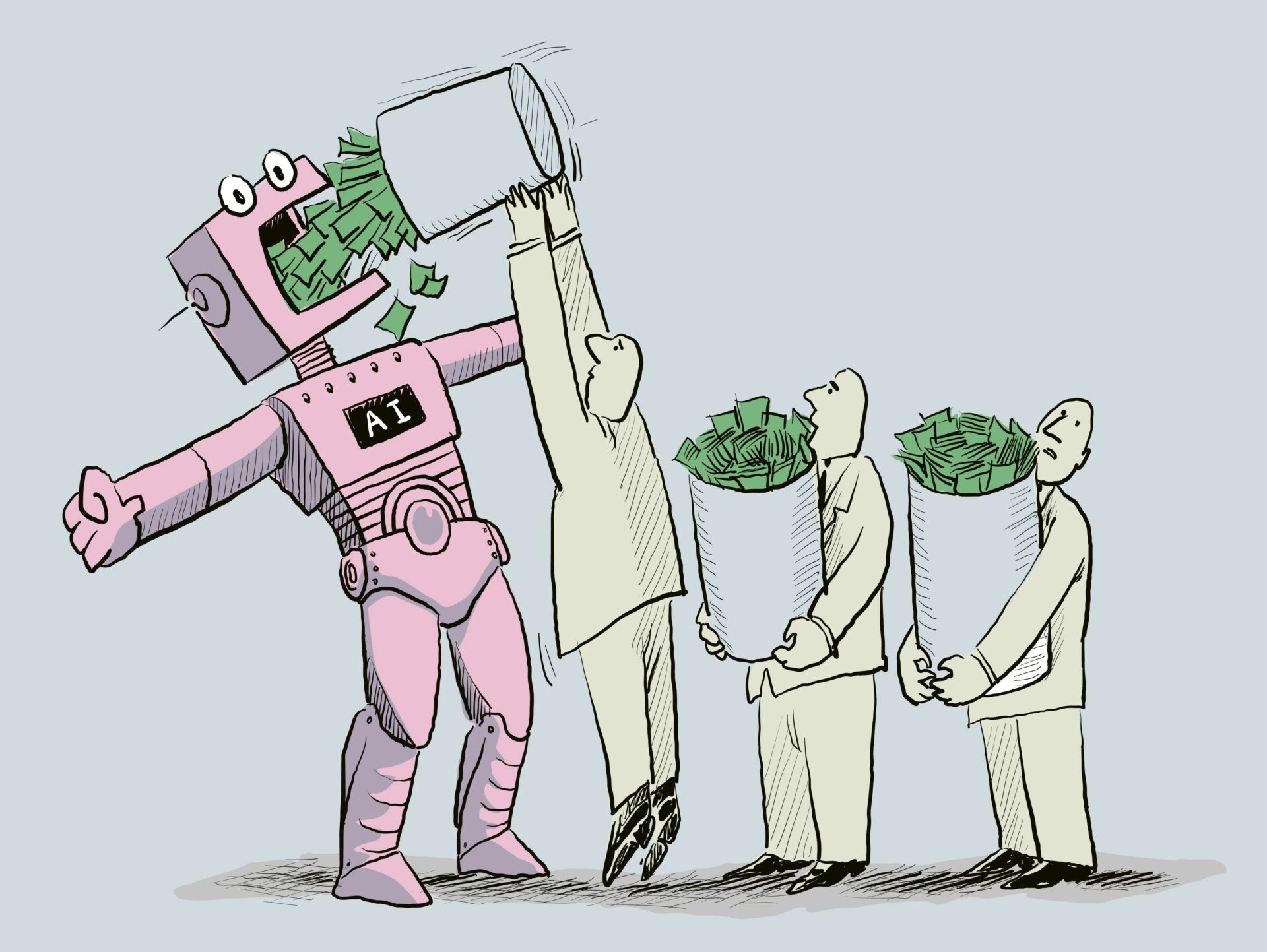
A complaint I hear a lot from my millennial peers is that our parents didn’t teach us enough about money. I can say that personal finance wasn’t dinner table conversation in my house, and even as I went off to college and started fending for myself, it was almost a taboo subject. When it came to money, people either had it or they didn’t, and you definitely didn’t talk about it.
Maybe this is why the average American isn’t exactly fluent in personal finance, and the situation is getting worse. Americans can only answer about 50 percent of basic questions about borrowing, savings, and risk on a financial literacy survey, according to a 2026 study by TIAA, a retirement services company. About a third of those surveyed said they have a hard time making ends meet and are debt-constrained. These figures have remained relatively unchanged for nearly a decade, but dropped to their lowest level in this year’s study.
It makes sense: It’s hard to learn about money when it’s not taught in schools, and it’s such an intensely private topic. It’s also hard to make good financial decisions when you’re one of the growing number of American households struggling to pay bills, repay debts, and save for the future — and feeling very stressed about it.
In a perfect world, each of us could sit down with a financial adviser to get help — but most of us can’t afford that. Instead, average Americans tend to find personal finance tips on TikTok, in Reddit threads, by watching Suze Orman on YouTube or How to Get Rich on Netflix, or by Googling their questions.
Now we have AI tools, too.
With access to an internet’s worth of information and financial advice, ChatGPT, Claude, and other AI chatbots can answer any question you ask. They can help you put together a basic budget or, armed with your bank statements and the details of your student loans and your retirement accounts, tailor solutions to your specific situation. Or, at least, that’s the promise.
Key takeaways
More people are turning to AI for financial advice: One in five Americans have used AI to help manage their money, and some experts think chatbots could be better than the status quo.
AI works best if you know what questions to ask: Those with basic financial literacy will be able to make the most of these tools, while those without it — who might need help the most — could be led astray.
Better advice comes with greater risks: Sharing your financial information with a chatbot helps personalize its recommendations. This raises privacy concerns, so you might want to delete your data when you’re done.
Think of AI as a financially savvy friend: Chatbots can answer money questions you might be embarrassed to ask someone else and use that context to help build your budget.
AI could create a more utopian, more equitable future, where reliable, hyper-personalized advice is just a prompt or two away for people who can’t afford to meet with an expert in real life. But machines are built by people, and there’s good reason to be concerned that these machines will simply replicate the biases and disparities built into our current system.
Here’s what experts say about how to make the most of these tools — and how to think about all of the inherent risks of uploading a lot of personal financial information to a chatbot or, worse, giving an AI agent the keys to your bank account.
The steep rise, risks, and rewards of AI financial advisers
Nearly 20 percent of Americans have used AI tools like ChatGPT for financial advice, and close to 25 percent for Gen Z adults and millennials have tried it, according to an August Gallup poll. These numbers could tick up too: In October, OpenAI started rolling out a dedicated personal finance tool to its ChatGPT Free and Go users in the United States, which effectively means anyone can try it. ChatGPT Finances lets you securely connect your bank account to the tool using a platform called Plaid, and then you can basically have a conversation with the chatbot about your real-time finances down to the penny. It’s like an AI-powered Mint (RIP) that you can talk to directly.
Regardless of where you encounter a chatbot or how much data you give it, experts say these tools could genuinely help improve financial literacy. You can talk to them about money problems you’re too embarrassed to discuss with friends and family, or ask questions and receive actionable, personalized information. There are real upsides to using AI this way.
Taha Choukhmane, an associate professor of finance at the MIT Sloan School of Management, has been studying outcomes when people turn to chatbots for financial advice. In general, these AI tools give pretty good advice, and that advice gets better as people become more practiced in asking the right question, according to research he published earlier this year.
“We were actually quite surprised that relative to the status quo, the average American would be better off if they were to follow the advice,” Choukhmane told me. But he added a caveat: “Just following the advice without understanding the advice puts you at risk of not fully understanding the risk.”
But you shouldn’t trust everything a chatbot tells you and should verify everything before making any decisions.
Chatbot advice has some significant limitations. First, it’s not impartial. The finance industry has a vested interest in steering you toward certain ways of managing your money, and that typically means selling you products, like loans. If you’ve ever searched for personal finance tips on Google, you’ve probably noticed that a lot of the top results come from banks and other financial institutions. This is by design, according to John Campbell, an economics professor at Harvard. But because AI is aggregating all of that advice, the specific influences and possible bias is less obvious.
“AI is very promising for providing low-cost financial advice in plain English that will arguably be better than what many people would be able to do on their own,” said Campbell, who’s also the co-author of Fixed: Why Personal Finance Is Broken and How to Make It Work for Everyone. “One caveat is that chatbot advice is quite likely — unless a model has been carefully trained — to reflect the average of whatever’s being posted on the internet, and that may or may not be first-rate advice.”
An example Campbell gives is the question of when to start taking Social Security benefits. While you’re eligible at age 62, many economists agree that you should delay your benefits, which, based on the way the government calculates your monthly payouts, will allow you to enjoy much higher benefits later in life. But paid financial advisers can recommend starting as early as possible, since waiting longer reduces the amount of money that needs to be managed, which reduces the adviser’s fees. That means there’s a lot of conflicting advice online, much of it supplied by the finance industry. And that’s the information used to train AI models.
“The advice is much more mixed,” Campbell said. “And so if a chatbot is learning from that, it may not actually give the best advice.”
It can be hard to recognize bad advice anywhere in life, but especially when you’re talking to a machine that’s programmed to please you. A chatbot could encourage you to consider a balance transfer, to lean in on credit card rewards, or to refinance your mortgage — all decisions with upsides and downsides for you, but definite upsides for banks — without you realizing how much of its training data comes from the finance industry selling these products. What’s worse is that if you do end up taking bad advice, it might be years before you realize it. You won’t know that you refinanced a mortgage at a bad time until a better time comes along.
That leads me to the other major issue with using chatbots for money advice: People who lack financial literacy are the most likely to fall for bad advice, because they simply don’t recognize it as such. They also tend to be less wealthy, which means they can’t afford big mistakes.
One way to mitigate risk, oddly enough, is to give the AI chatbot more personal information. The more details about your situation it has to consider, the more it can offer personalized advice. More context also means better advice, according to Choukhmane.
“There’s a trade-off there,” Choukhmane said. “There’s real risk around privacy, and so I think everyone needs to find their level of control.”
Don’t assume your data is safe
Any time you’re talking to a chatbot, you’re putting a lot of trust in tech companies to take care of the personal details you’re sharing. Sending sensitive financial data is an especially risky proposition. While tech companies, including OpenAI, promise to keep your data secure, there’s already a long list of breaches, leaks, and privacy violations that serve as cautionary tales.
It’s also impossible to know what tech companies might do with your data in the future. Most of them will use it to train their models, unless you tell them not to. Some of them will use the data to serve you personalized ads.
Then there’s the risk of bad actors getting into your ChatGPT, Claude, or Gemini account. If you’ve been using a chatbot for financial advice and uploading your bank statements, a hacker could gain access to a stunning amount of information that could enable them to do all kinds of terrible things to your life.
“They could steal your identity and open accounts and then quickly bankrupt a person,” said Delicia Reynolds Hand, a senior director at Consumer Reports. “It’s not even so much the primary underlying accounts that could be at risk, it’s more just access to this information.”
The steady march of AI progress is making this situation even more complicated. The previous era of chatbots offering financial advice is quickly bleeding into a new phase of AI agents logging into bank accounts on users’ behalf. If you’re using a tool like Claude Cowork or even an AI assistant like Muse, you can give an agent the login credentials to your bank account, and because the agent is operating its own computer, it can actually make transfers, apply for loans, or really do anything in your account. This is reportedly driving major banks wild, since they don’t know which logins are coming from humans and which are agents. And because we know that AI agents are unpredictable, it’s hard to know how that access might go wrong.
Beyond data security and privacy, you should also be aware of the simple fact that nobody’s really at fault if you end up losing money using these tools. Chatbots are not regulated in the way that human financial advisers, who have a fiduciary duty to act in your best interest, are.
“If I get bad tax advice from H&R Block or a tax adviser, there are a clear set of rules and guardrails in place to manage what I can expect in that relationship and where the service they use has liability and where that liability ends,” Hand said. “Currently, that’s not the case for these tools.”
Trust but verify — and then delete your data
In the final years of the Cold War, Ronald Reagan popularized an old Russian proverb: Trust, but verify. The phrase is somewhat nonsensical, since trusting someone implies that you don’t need to verify what they’re saying, and verifying what’s said implies you didn’t trust them in the first place. But if you are willing to shoulder a bit of risk, consider approaching AI this way, especially when your life savings are on the line. I’d also suggest adding a coda to the phrase: And then delete your data.
Chatbots are not stand-ins for licensed financial advisers, he said, and you shouldn’t let them make decisions for you.
The great paradox with tools like ChatGPT and Claude is that they’re very good at generating truthy text. It sounds authoritative and looks correct — and usually is. Except when it isn’t. AI is famously unpredictable and prone to hallucinations. You can ask the same question twice and get two different answers. That doesn’t mean these tools are useless. It just means you have to approach them with caution. You have to interrogate these chatbots, challenge whatever advice they give you, and then crosscheck that with other, more reputable, sources.
“If you’ve never used these tools, I would not encourage you to just change all your financial plans based on your first conversation,” Choukhmane said. “You want to be quite careful. Start using these tools, start understanding, ask a lot of follow-up questions.”
When it comes to mitigating risk, consider giving ballpark figures for your income or spending when you’re talking to a chatbot about your finances. Uploading financial documents, even if they’re redacted, is inevitably filling a tech company’s vault with your sensitive information without necessarily knowing what will happen to it next. You should also dig into your privacy and security settings to make sure you’ve turned on multi-factor authentication and that your personal data is not being used to train AI models and gets deleted after 30 days.
Ethan Bloch, the product lead for ChatGPT for Financial Services, made a similar set of recommendations when I talked to him recently. Chatbots are not stand-ins for licensed financial advisers, he said, and you shouldn’t let them make decisions for you. They’re designed to inform and help you think through complex topics.
“You should liken it to just talking to a friend who has some very informed opinions about finance,” Bloch told me. “But if you’re actually making some large financial decision — your portfolio or retirement — you still need to seek out the help.”
Regardless of how experienced you are with chatbots or how much data you’re prepared to hand over, remember what Campbell, the Harvard professor, said. If your financial literacy isn’t great, AI chatbots can be trouble. And if you’re like most Americans, you could probably stand to learn a little bit more about things like mortgages and interest rates.
Yes, Chatbots can be a good way to brush up on financial literacy. You can ask them the money questions you’re too embarrassed to discuss with friends and family. But you can also learn about money the old-fashioned way: Reading books and websites written by reputable, independent sources. The Federal Deposit Insurance Corp. has a portal of financial education resources, including games and quizzes. Khan Academy has a course that covers everything from credit scores to college savings. There’s a personal finance subreddit that I joined years ago and read almost daily. There are budgeting apps, like YNAB which has its own huge Reddit presence.
Whatever you do to learn more about personal finance, simply doing something is progress. Talking about personal finance isn’t the taboo it once was in the US, and it’s even a required course in the vast majority of American high schools now. And while AI won’t magically solve your money problems, it can help get you started. Just be careful. Your livelihood could be on the line.
