
DUBAI, United Arab Emirates, 1st September 2026, ZEX PR WIRE — ME Network, a next-generation blockchain infrastructure platform, today announced its PPoS (Permitted Proof of Stake) + ME-Tendermint consensus architecture, designed to balance security, trusted validator participation, efficiency, and scalability as blockchain infrastructure evolves toward DeFi, RWA, Rollup, and multi-chain applications.
As blockchain networks expand beyond single-chain applications, consensus mechanisms are increasingly required to address more than simply reaching agreement between distributed nodes. Networks must also balance security, decentralization, efficiency, validator participation, and scalability.
ME Network’s consensus architecture addresses these requirements by combining identity verification, economic staking, governance-based validator admission, and BFT-based consensus.
A New Approach to Validator Participation
At the core of ME Network’s architecture is Permitted Proof of Stake (PPoS).
Unlike traditional Proof of Stake models that primarily rely on token staking to determine validator participation, PPoS introduces additional validator admission requirements. Validators must meet staking requirements, complete identity verification, and pass the relevant governance review before joining the validator set.
This creates a model built around three complementary elements:
-
Economic security through MEC staking and Slashing mechanisms;
-
Trusted identity through validator identity verification; and
-
Governable participation through network-based validator admission and exit.
The approach is intended to create a framework in which validators are not simply anonymous addresses, but network participants with verifiable identities and defined responsibilities.
According to ME Network, this architecture is particularly relevant to application environments involving digital identity and Real-World Assets (RWA), where trusted participation can be an important component of the underlying infrastructure.
ME-Tendermint Provides BFT-Based Consensus
PPoS determines who can participate in consensus and under what conditions, while ME-Tendermint handles the underlying block consensus process.
Built on the Tendermint / CometBFT BFT consensus approach, ME-Tendermint uses multiple rounds of validator voting to confirm blocks without relying on the computational competition associated with Proof of Work.
Once more than two-thirds of validator voting power agrees on the same block, the block can reach final confirmation.
This architecture is designed to provide:
-
Fast finality, allowing confirmed blocks to reach finality without requiring multiple subsequent confirmations;
-
Consensus security through validator voting under BFT assumptions;
-
High efficiency without large-scale computational competition; and
-
Modular support, allowing the consensus layer to provide underlying security for components such as RollApp.
The architecture reflects ME Network’s approach to modular blockchain infrastructure: allowing the consensus layer to focus on trust, transaction ordering, block production, and final confirmation, while other network modules can focus on execution and scalability.
How Does the ME Network Consensus Process Work?
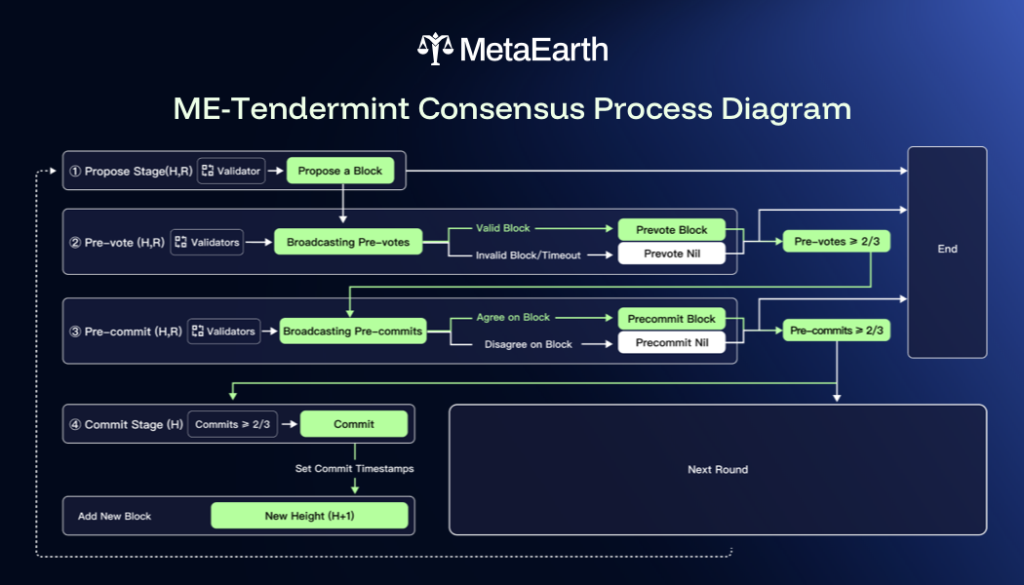
1. Proposal
At a given block height and round, the designated Proposal Validator packages transactions and creates a candidate block, which is then broadcast to other validators.
2. Pre-vote
Validators verify the proposed block, including its format, transaction validity, network state, and relationship to the previous block. If the block is valid, validators issue a Pre-vote. If the block is invalid or a timeout occurs, validators may vote Nil.
3. Pre-commit
When more than two-thirds of validator voting power supports the candidate block through Pre-votes, validators proceed to the Pre-commit stage and broadcast their Pre-commit messages.
4. Commit
When more than two-thirds of validator voting power supports the block through Pre-commits, the block enters the Commit stage. The block state is then written on-chain, final confirmation is achieved, and the network proceeds to the next block height.
This process enables ME Network to confirm blocks through validator coordination rather than relying on large amounts of computational power.
From Blockchain Security to Scalable Infrastructure
The evolution of blockchain consensus has progressed from Proof of Work toward Proof of Stake and BFT-based mechanisms as networks have sought different balances between security, efficiency, and scalability.
Bitcoin’s Proof of Work model establishes security through computational and energy costs. Proof of Stake introduces economic incentives and staking as mechanisms for securing the network. BFT-based mechanisms further emphasize rapid validator agreement and deterministic finality.
ME Network’s approach builds on these developments by combining identity, staking, governance, and BFT consensus within a modular architecture.
PPoS establishes the framework for trusted validator participation, while ME-Tendermint provides the mechanism for rapid block consensus. The broader modular architecture is designed to allow the consensus layer to work alongside Rollup, data availability, and other network components.
As blockchain infrastructure moves toward broader adoption and increasingly complex applications, ME Network believes the next stage of consensus development will not be defined solely by transaction throughput.
Instead, the focus will increasingly be on establishing a sustainable balance between security, decentralization, efficiency, trusted identity, and scalability.
About ME Network
Meta Earth is a modular, high-performance multi-chain network building the infrastructure for a globally inclusive digital economy. By combining a layered public chain architecture, a native KYC-enabled DID system, and a UBI-driven tokenomics model anchored to real user growth, the network delivers regulatory-friendly solutions and true economic empowerment to millions worldwide.
Learn More & Get Involved:
The Post ME Network Introduces PPoS + ME-Tendermint Consensus Architecture for Scalable Web3 Infrastructure first appeared on ZEX PR Wire
